
Jal Raksha
JAL RAKSHA INITIATIVE
Jal Raksha Initiative
PROJECT AQUA‑SPECTRA
WATER HEALTH & ECOLOGICAL INTELLIGENCE PLATFORM
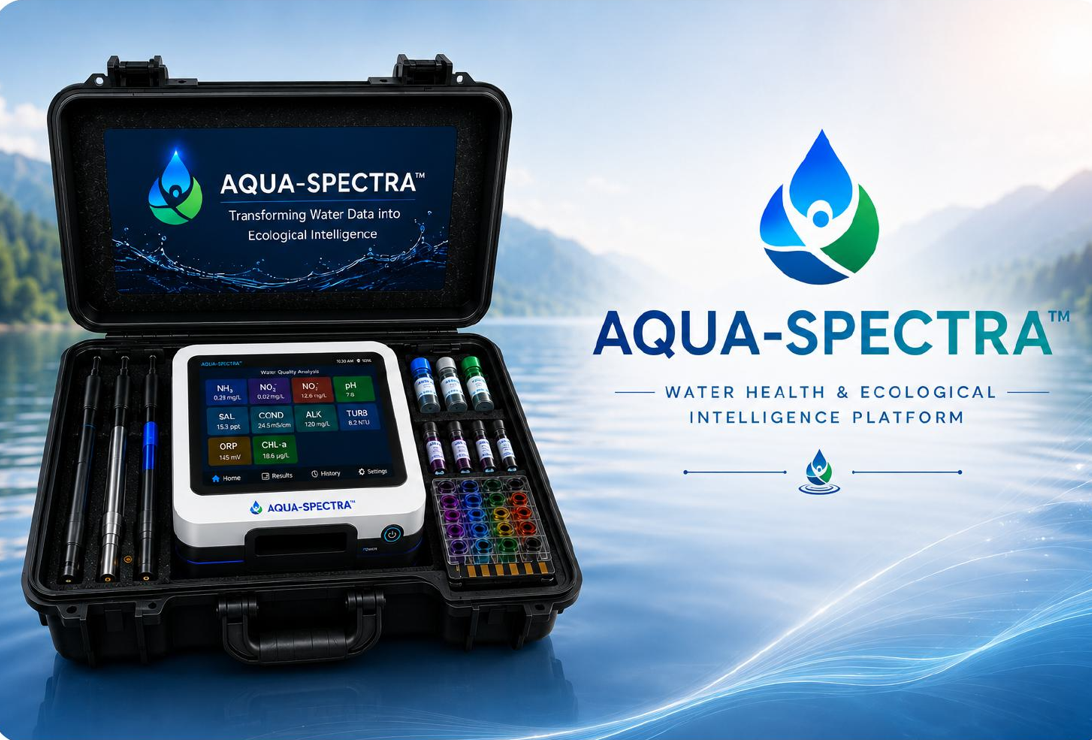
AQUA-SPECTRA™ · FIELD ANALYSIS KIT
NH₃0.29 mg/L
NO₂0.02 mg/L
NO₃12.6 mg/L
pH7.6
SAL15.3 ppt
COND24.5 mS/cm
ALK120 mg/L
TURB8.2 NTU
ORP145 mV
CHL-a18.6 µg/L
Jal Raksha is a pioneering initiative dedicated to transforming aquaculture and aquatic ecosystem management through the convergence of biosensing, artificial intelligence, environmental intelligence, and digital technologies. Designed to address the growing challenges of water quality degradation, disease outbreaks, environmental stress, and sustainable food production, the initiative aims to build next-generation smart solutions for shrimp farming, fisheries, freshwater systems, and aquatic ecosystems.
At the heart of the initiative is Aqua-Spectra — an AI-powered portable biosensing platform that integrates water quality monitoring, shrimp health assessment, pathogen surveillance, sediment analysis, feed quality evaluation, antibiotic residue detection, and ecological intelligence into a single intelligent ecosystem. By combining advanced electrochemical sensing, spectroscopy, molecular diagnostics, IoT connectivity, and predictive AI analytics, Jal Raksha empowers farmers, researchers, industries, and policymakers with real-time insights for precision aquaculture, early disease detection, sustainable resource management, and data-driven decision-making.
Jal Raksha envisions a future where every water body can be continuously monitored, every aquatic organism can be proactively protected, and every farming decision is guided by science, intelligence, and sustainability.
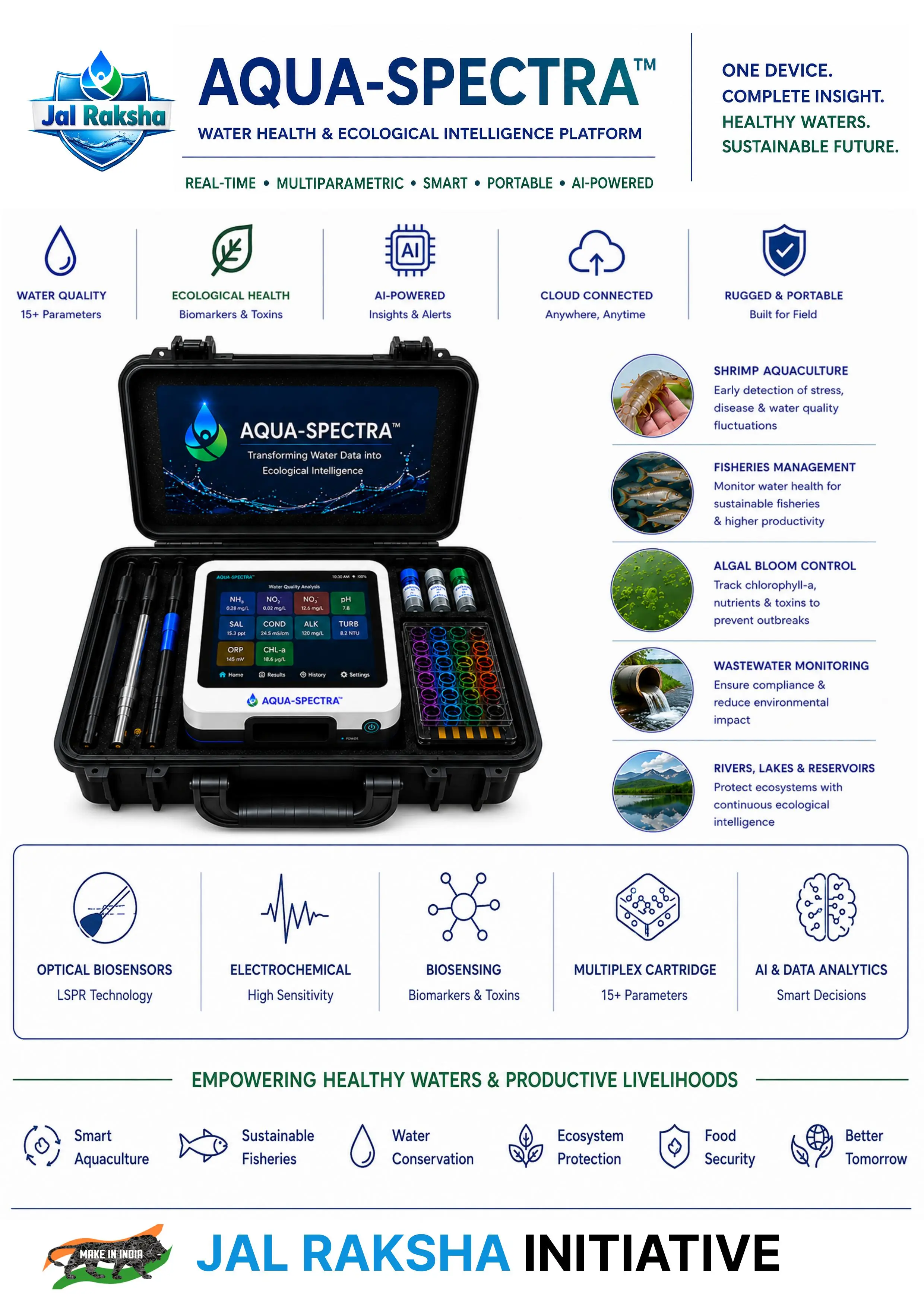

AQUA-SPECTRATM
WATER HEALTH & ECOLOGICAL INTELLIGENCE PLATFORM
HEALTHY WATERS.
SUSTAINABLE FUTURE.
OUR SERVICES
WATER QUALITY
MONITORING
ECOLOGICAL & TOXIN
BIOMONITORING
AI-POWERED
ANALYTICS
CLOUD CONNECTIVITY
& DATA PLATFORM
RUGGED & PORTABLE
SOLUTIONS
SHRIMP AQUACULTURE
MANAGEMENT
FISHERIES & POND
MANAGEMENT
ALGAL BLOOM
MONITORING
WASTEWATER
MONITORING
RIVERS, LAKES &
RESERVOIRS
MULTIPARAMETRIC
SENSING
LAB & FIELD
TESTING SERVICES
REPORTS &
COMPLIANCE
MOBILE APP &
DASHBOARD
TRAINING &
CONSULTING
Aqua-Spectra provides an integrated suite of AI-powered water, aquaculture, and ecological intelligence services designed to support sustainable aquatic ecosystem management. Combining advanced biosensors, electrochemical sensing, spectroscopy, molecular diagnostics, IoT, cloud computing, and artificial intelligence, the platform delivers real-time monitoring, predictive analytics, and decision support across water quality, shrimp health, pathogen surveillance, sediment quality, feed quality, environmental monitoring, and regulatory compliance. Aqua-Spectra enables farmers, industries, researchers, and government agencies to make faster, data-driven decisions that improve productivity, reduce disease risks, optimize resource utilization, and promote long-term environmental sustainability.
SMARTER
DECISIONS
SUSTAINABLE
FUTURE
BETTER
PRODUCTIVITY
ANYWHERE,
ANYTIME
PARTNER IN
PROGRESS
Project Team
Leadership & Scientific Team
The people behind Aqua-Spectra — combining decades of analytical science, engineering, and field research experience.

Dr. K.V.S. Satyanarayana
Bio Medical Scientist
He obtained his Ph.D. in Medical Biosciences from the University of Bradford, United Kingdom, under the prestigious Commonwealth Scholarship Commission, where his research focused on phytotherapeutic natural products, bioactive compound isolation, and advanced analytical characterization. His scientific contributions include the discovery of novel natural compounds and multiple peer-reviewed international publications.
Throughout his career, Dr. Satyanarayana has held research, teaching, and industrial leadership positions at CSIR laboratories, GITAM University, S.V. Enviro Labs, and Enanti Labs Pvt. Ltd. His expertise encompasses analytical chemistry, environmental analysis, pharmaceutical quality control, analytical method development, natural product chemistry, and laboratory quality systems. He has extensive hands-on experience with advanced analytical instrumentation, including ICP-OES, ICP-MS, HPLC, GC, GC-MS, LC-MS, AAS, UV-Visible Spectroscopy, FTIR, XRF, XRD, NMR, and HPTLC, enabling accurate characterization of water, environmental, pharmaceutical, herbal, and biological samples. His proficiency also extends to laboratory accreditation systems, including GLP, GMP, ISO/IEC 17025, NABL, ICH guidelines, SOP development, and quality assurance, providing a strong foundation for research standardization and technology validation.
Dr. Satyanarayana has successfully led and contributed to several nationally and internationally funded research projects and has published extensively in high-impact journals. His research portfolio includes environmental analytical chemistry, bioremediation of heavy metals from aqueous systems, phytochemical characterization, natural product standardization, and development of analytical protocols for medicinal and environmental samples. His industrial experience in accredited environmental laboratories has further strengthened his expertise in water quality analysis, contaminant assessment, trace element analysis, and environmental monitoring.
As the Lead Principal Investigator of the proposed Aqua-Spectra project, Dr. Satyanarayana will provide scientific leadership in analytical method development, environmental sample characterization, laboratory validation, and quality assurance. His extensive experience in analytical instrumentation, environmental chemistry, and accredited laboratory practices will ensure the development of reliable, scientifically validated, and field-deployable sensing technologies for comprehensive water quality assessment. His expertise will guide the standardization of analytical protocols, calibration methodologies, performance validation, and integration of laboratory-grade analytical approaches into portable biosensing platforms.
Dr. A.V.N.L. Sharma
academic leader, researcher, and mechanical engineering expert
after previously holding the positions of Dean (Academics), Professor and Head of the Department, and senior academic leadership roles across reputed engineering institutions. His extensive experience in institutional governance, interdisciplinary research, and engineering education provides a strong foundation for leading large-scale collaborative research and technology development programmes.
Dr. Sharma's research expertise includes manufacturing engineering, advanced materials, computational modelling, optimization techniques, predictive modelling, corrosion engineering, thermal systems, nanomaterials, and product design. His doctoral research focused on multi-objective optimization and predictive modelling of machining processes, while his recent publications address advanced materials processing, laser welding, heat transfer enhancement using nanofluids, mathematical modelling, deep-water sandwich pipe technologies, and corrosion-resistant composite materials. These contributions demonstrate his expertise in translating engineering principles into practical industrial applications through multidisciplinary research and advanced manufacturing technologies.
Throughout his academic career, Dr. Sharma has actively promoted innovation, research commercialization, and industry–academia collaboration. He has guided multiple doctoral scholars, contributed to patent development in advanced engineering and emerging technologies, and authored scholarly publications in internationally recognized journals. His recent intellectual property portfolio includes innovations related to fluid distribution systems, corrosion-resistant sandwich pipe technologies, and multidisciplinary engineering solutions. His continued engagement in research supervision and innovation has fostered an ecosystem that supports technology development and translational research across healthcare, environmental engineering, and industrial applications.
As the Lead Principal Investigator of the proposed Aqua-Spectra project, Dr. Sharma will provide strategic scientific leadership, interdisciplinary research coordination, institutional oversight, and engineering guidance for the successful execution of the project. His role will encompass research planning, technology integration, engineering design optimization, prototype development, innovation management, and coordination among multidisciplinary investigators from engineering, environmental science, biotechnology, and aquaculture. He will oversee the translation of laboratory-scale innovations into robust field-deployable technologies while ensuring scientific quality, project governance, and effective collaboration with industrial and academic partners. His expertise in engineering optimization, product development, innovation management, and institutional leadership will be instrumental in advancing Aqua-Spectra from research to translational deployment.
Dr. Sharma's distinguished academic leadership, engineering expertise, innovation-driven research, extensive publication record, and commitment to multidisciplinary collaboration make him exceptionally well suited to lead the Aqua-Spectra project. His guidance will strengthen the project's engineering excellence, translational research outcomes, technology commercialization, and long-term sustainability, contributing significantly to the development of next-generation intelligent water quality monitoring and environmental health assessment technologies.

Mr. Kolla Venkata Atchuta Rao
Innovator and Research
He is currently pursuing doctoral research in Industrial Biotechnology and has multidisciplinary experience spanning biotechnology, biosensor engineering, healthcare technologies, environmental sensing, and startup-led technology translation.
He has developed substantial expertise in nanoparticle synthesis, optical fiber sensing, optical nanofiber systems, electrochemical sensing platforms, screen-printed electrode fabrication, biosensor surface functionalization, prototype development, and analytical validation. Preliminary work carried out by the investigator includes successful synthesis and characterization of gold nanoparticles and silver nanostructures, development of optical sensing probes, fabrication of custom screen-printed electrodes, electrochemical characterization, calibration studies, and prototype sensor development. These activities provide the technological foundation for the proposed Aqua-Spectra Water Health and Ecological Intelligence Platform.
He has contributed to scientific publications in biosensors and nanotechnology and has generated multiple patent applications related to biosensors, diagnostic systems, sensing devices, and healthcare technologies. In addition, experience in startup incubation, intellectual-property development, prototype engineering, and technology commercialization provides a strong translational pathway for the proposed research.
He leads the sensor development, ecological biosensing, platform integration, AI-assisted environmental intelligence development, field validation, intellectual-property generation, and technology translation activities under the project.
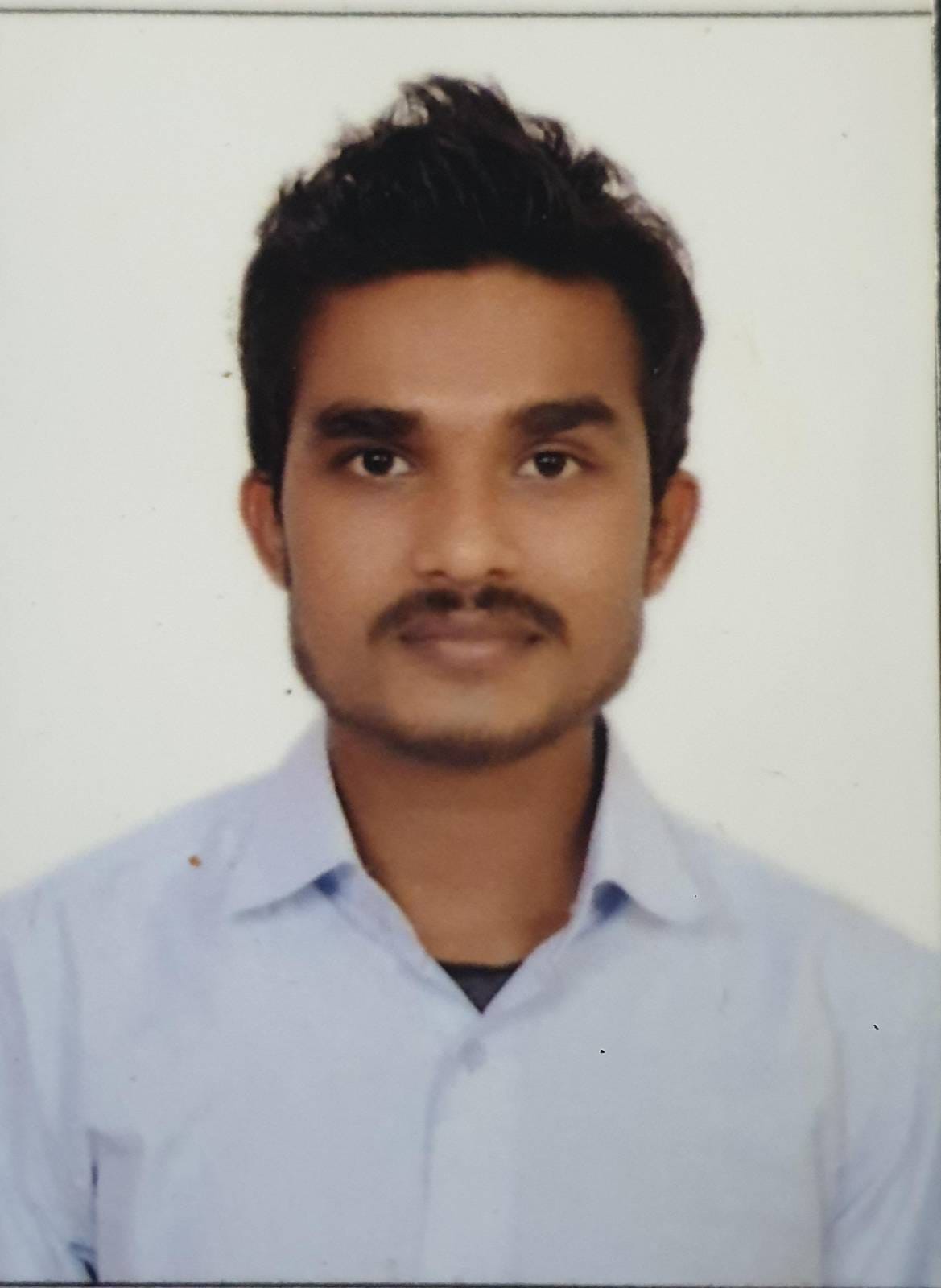
Nitesh Kumar
AI/ML Expert
His expertise spans Artificial Intelligence, Large Language Models (LLMs), multi-agent systems, workflow automation, medical AI, IoT analytics, cloud-based platforms, and full-stack software engineering. Throughout his professional career, he has focused on translating complex scientific and engineering challenges into scalable, production-ready AI solutions capable of real-world deployment.
His professional experience includes developing AI-driven healthcare applications, autonomous agent systems, retrieval-augmented generation (RAG) platforms, predictive analytics, conversational AI, and intelligent workflow orchestration. He has successfully architected end-to-end AI automation platforms integrating multi-agent reasoning, contextual memory, tool orchestration, and autonomous decision-making using modern LLM frameworks. His technical proficiency includes Python, FastAPI, REST APIs, PostgreSQL, Svelte, distributed computing, cloud-native architectures, API integrations, and scalable SaaS platform development. He also possesses strong expertise in AI-assisted IoT systems, real-time sensor data processing, event-driven architectures, asynchronous execution pipelines, and intelligent automation frameworks.
He has contributed to the development of several innovative AI-enabled healthcare technologies, including real-time maternal health monitoring systems, AI-assisted clinical decision support, medical image analysis, and intelligent biomedical data management platforms. His work on machine learning-based physiological signal processing, healthcare workflow automation, and AI-powered clinical chatbots demonstrates his ability to integrate artificial intelligence with biomedical and sensor technologies for practical healthcare applications. His experience in rapid software prototyping, system architecture, and production deployment enables efficient translation of research concepts into user-centric digital solutions.
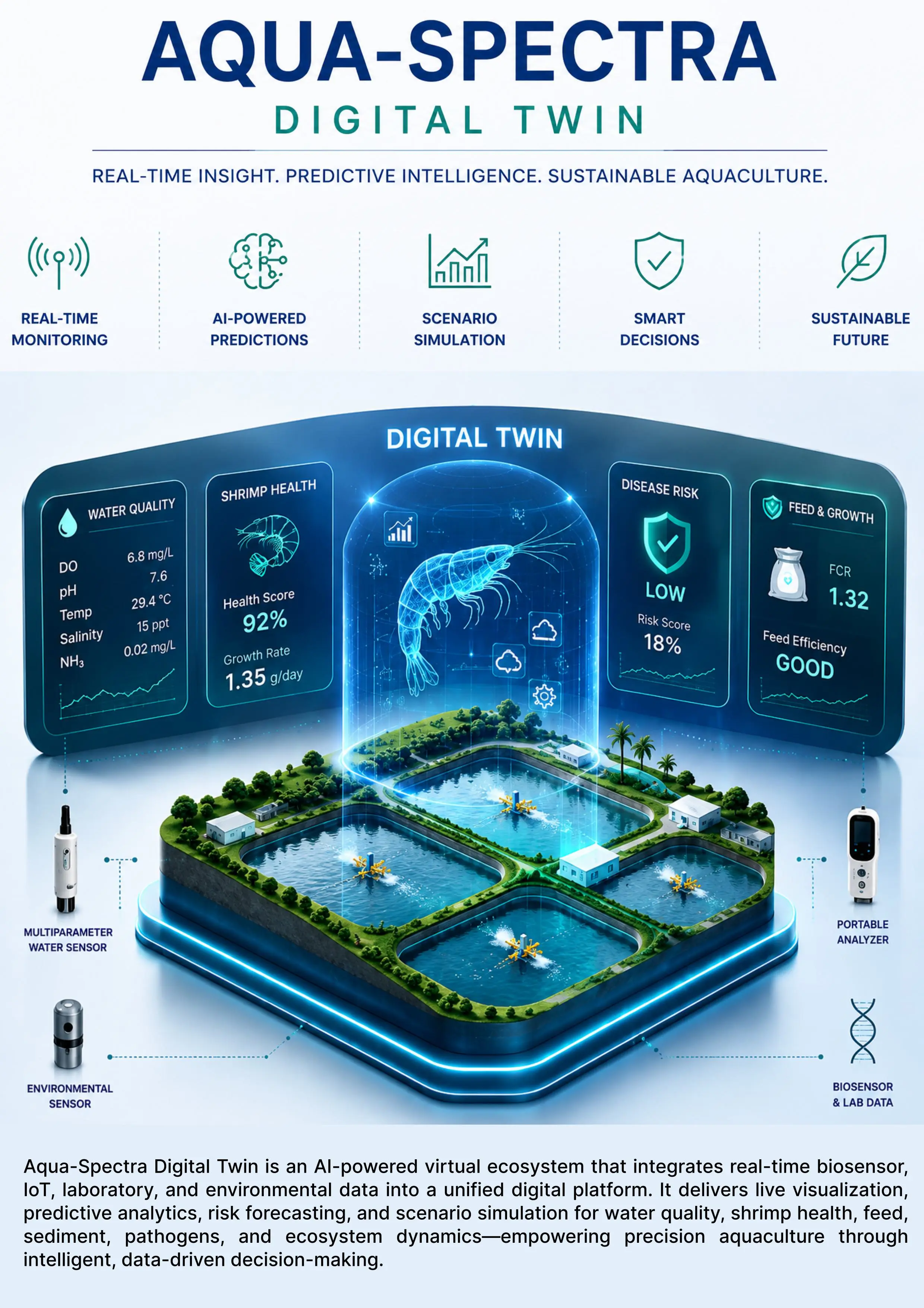
As the Artificial Intelligence and Digital Platform Lead for the proposed Aqua-Spectra project, Mr. Kumar will lead the design and development of the project's AI-driven environmental intelligence platform, multi-agent decision support system, cloud infrastructure, and digital twin ecosystem. His responsibilities will include developing AI models for water quality prediction, ecological risk assessment, anomaly detection, intelligent recommendation systems, and predictive analytics using multimodal environmental and biosensor data. He will also oversee the development of the Aqua-Spectra mobile application, cloud-based data management platform, user dashboards, API integration, IoT connectivity, and AI-assisted decision support modules for farmers, researchers, and regulatory agencies. His expertise in autonomous AI agents, intelligent workflow orchestration, and scalable software architecture will enable seamless integration of biosensing hardware, IoT devices, laboratory data, and artificial intelligence into a unified environmental monitoring platform.
Mr. Nitesh Kumar's multidisciplinary expertise in artificial intelligence, software engineering, IoT integration, healthcare analytics, and intelligent automation makes him a key technology leader for the Aqua-Spectra project. His capability to bridge advanced AI methodologies with field-deployable digital solutions will play a critical role in delivering a robust, scalable, and user-centric environmental intelligence platform for precision water quality monitoring and sustainable aquatic ecosystem management.
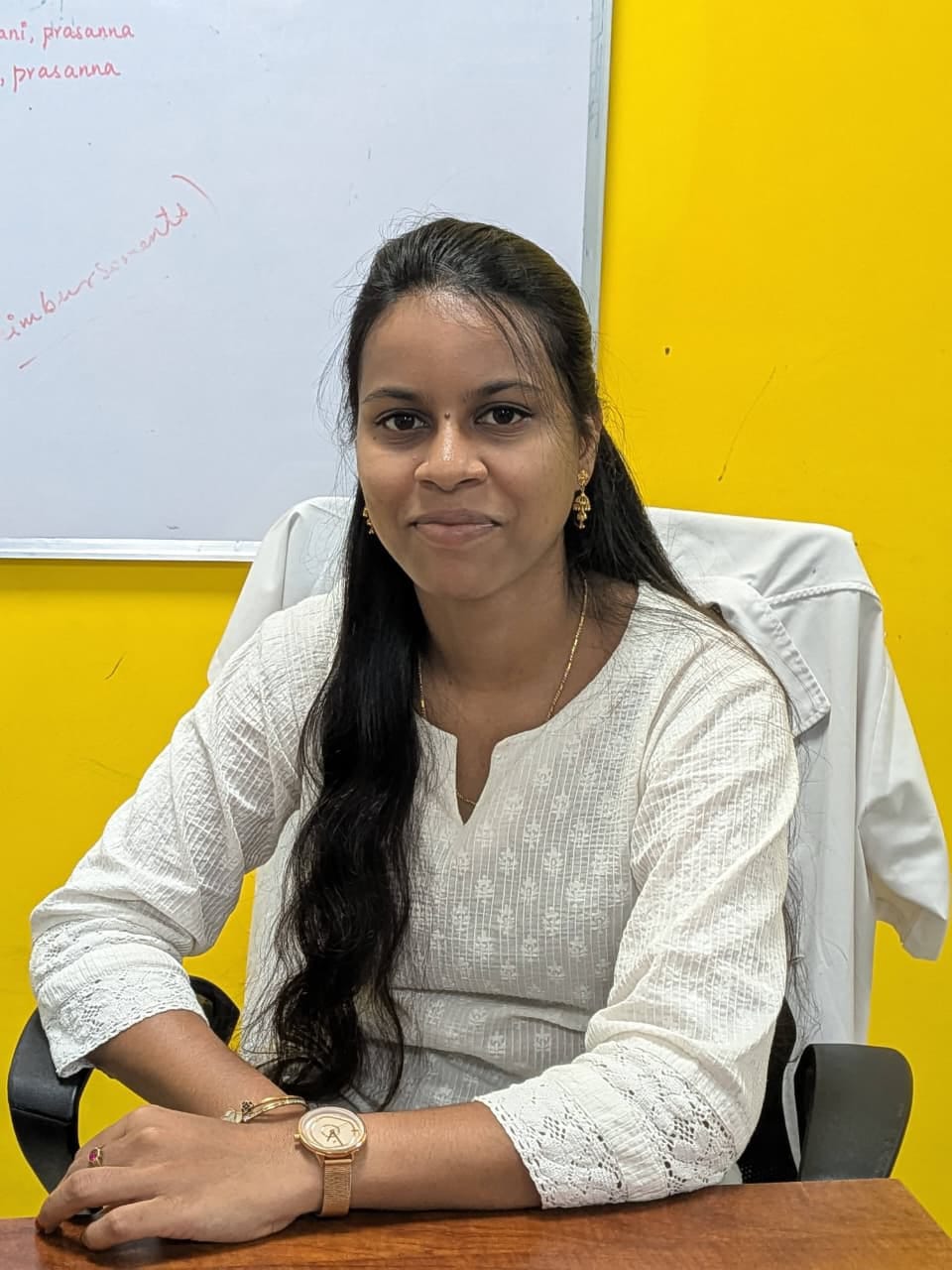
Ms. Pushpavalli Rokkala
Agricultural & Biomedical Expert
I am currently serving as the Chief Operations Officer at Biomexia Healthcare Private Limited, where I oversees operational planning, cross-functional coordination, strategic implementation, and organizational management.
My professional experience includes research and development of biomedical devices, clinical evaluation of maternal and fetal monitoring systems, regulatory compliance, medical device testing, documentation for NABL/NABH quality systems, and product demonstrations for healthcare professionals. I have contributed to prototype development, validation, data collection, clinical usability studies, and operational optimization across multiple healthcare organizations.
Her research interests include biomedical engineering, artificial intelligence in healthcare, medical device innovation, healthcare operations, digital health technologies, biomedical signal analysis, and clinical product validation. I have published research on machine learning based prediction of thyroid disease and has practical expertise in integrating engineering solutions into clinical environments.
She possess strong skills in project management, regulatory compliance, operational strategy, quality documentation, stakeholder engagement, process optimization, leadership, and multidisciplinary team coordination. My long-term objective is to contribute to the development and commercialization of innovative medical technologies that improve healthcare accessibility, quality, and patient outcomes while supporting translational research and industrial innovation.